

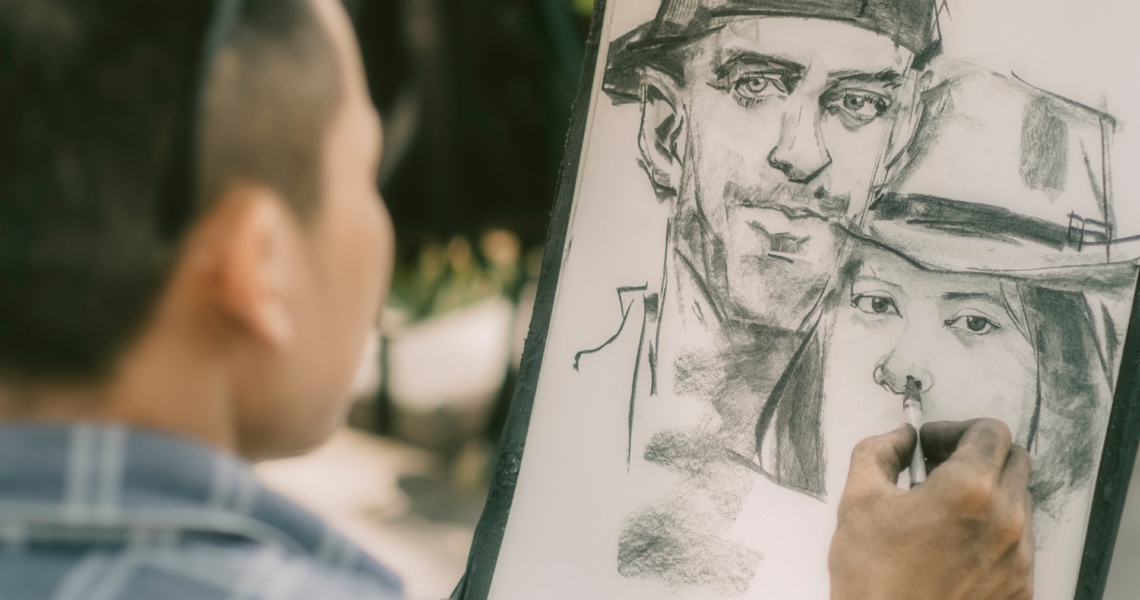
Accurately sketching faces is a skill that many artists strive to master, whether they are beginners or experienced practitioners. By breaking down the structure of the face into simple shapes and understanding proportions, anyone can improve their ability to create lifelike portraits. This article will provide practical techniques to enhance face sketching skills, making the process more accessible.
Understanding the proportions of the human face is critical. The face can be divided into sections to identify key features like the eyes, nose, and mouth. Familiarity with these proportions simplifies the sketching process and enables better representation of individual characteristics.
Practicing with various reference images can further aid in developing this skill. Artists can learn how to capture different angles, expressions, and ethnic features, enriching their understanding of facial diversity. Discovering unique styles in portraiture also adds personal flair to their work.
Understanding Facial Proportions
Accurate facial proportions are crucial for creating realistic sketches. By familiarizing oneself with key guidelines, artists can ensure their depictions are both balanced and lifelike.
The Rule of Thirds and Fifths
The Rule of Thirds is a foundational principle in art. It divides the face into three equal horizontal sections: forehead to eyebrows, eyebrows to nose, and nose to chin. Each section should be approximately one-third of the total head height.
When applying the Rule of Fifths, the face divides into five equal vertical sections. Eyes occupy the second and fourth sections, with the inner corners aligned with the first and fifth sections. The nose typically sits in the middle section, while the mouth spans across the second and fourth sections.
These rules provide a framework for understanding spacing and placement, enhancing accuracy in sketches.
Frontal vs. Profile View
Facial proportions vary significantly between frontal and profile views. In a frontal view, the eyes are approximately halfway down the head. The space between the eyes is roughly equal to the width of one eye.
In profile view, measuring from the forehead to the chin, the nose protrudes forward approximately the same distance as the forehead. The chin and mouth align vertically with the forehead and nose tip. Understanding these distinctions allows artists to create depth and perspective in their work.
By mastering these proportions, artists can produce well-structured and convincing facial drawings.
Capturing Facial Features
Accurate representation of facial features is crucial in sketching. Each key element contributes to the likeness and expressiveness of a face. This section focuses on critical aspects: eyes and eyebrows, nose and lips, and ear placement.
Eyes and Eyebrows
Eyes are often referred to as the window to the soul. When sketching, attention should be paid to their shape, size, and placement. The distance between the eyes typically equals one eye’s width.
Eyebrow shape impacts facial expression significantly. They should align with the outer corners of the eyes. Different styles—arched, straight, or curved—convey various emotions.
Tip: Use reference images to compare proportions. Capturing subtle shading within the eye can enhance realism. Light reflections—often found in the pupils—add depth, making the eyes appear more lifelike.
Nose and Lips
Nose shape varies widely between individuals. A common method involves sketching the nose as a simple geometric shape before adding details. The position can be determined by the line drawn between the inner corners of the eyes, extending down to the base of the nose.
Lips should follow the natural curve observed in individuals. The upper lip often appears thinner than the lower lip. Key features include the philtrum, which exists between the nose and the upper lip.
Tip: Shading is critical around the nose and lips. This adds dimension and helps define these features distinctly. Capturing the subtle differences in lip fullness can enhance character in sketches.
Ear Placement
Ears are often overlooked but are essential for accuracy. They generally align with the eyebrows and the base of the nose. Understanding ear structure aids in achieving the correct size and shape.
The outer edge of the ear has significant variations, making each ear unique. Observe details such as the helix and earlobe shapes.
Tip: Sketching ears can be simplified by breaking them into basic shapes. Focus on the angles and curves to define their form in relation to the head. Using light strokes allows for adjustments and corrections as the sketch progresses.
Shading Techniques for Realism
Accurate shading is essential for capturing the contours and depth of a face. Focusing on the light source and skin textures significantly enhances realism in sketches.
Light Source and Shadow
Establishing a clear light source is critical. It determines where highlights and shadows fall on the face. Artists should visualize this before beginning their shading.
- Identify the light source: Determine if it’s natural or artificial.
- Observe the shadows: Notice how they form on different areas such as the cheekbones, under the nose, and around the jawline.
Use soft pencils (such as 2B to 6B) for darker shadows. Gradually blend with a blending stump to create a smooth transition between light and dark areas. The goal is to mimic how light interacts with skin, producing realistic depth.
Skin Textures
Understanding skin textures adds complexity to facial sketches. Skin is not uniform; it has varying textures influenced by factors like age and health.
Begin by studying skin types. Some may be smooth, while others exhibit pores or wrinkles.
- Use short strokes: For smoother areas, apply delicate, short strokes.
- Darker tones for detail: For wrinkles or texture, use slightly darker tones to create depth.
Adding subtle variations in shade can suggest features like freckles or blemishes. This attention to detail helps communicate the unique quality of each face.