

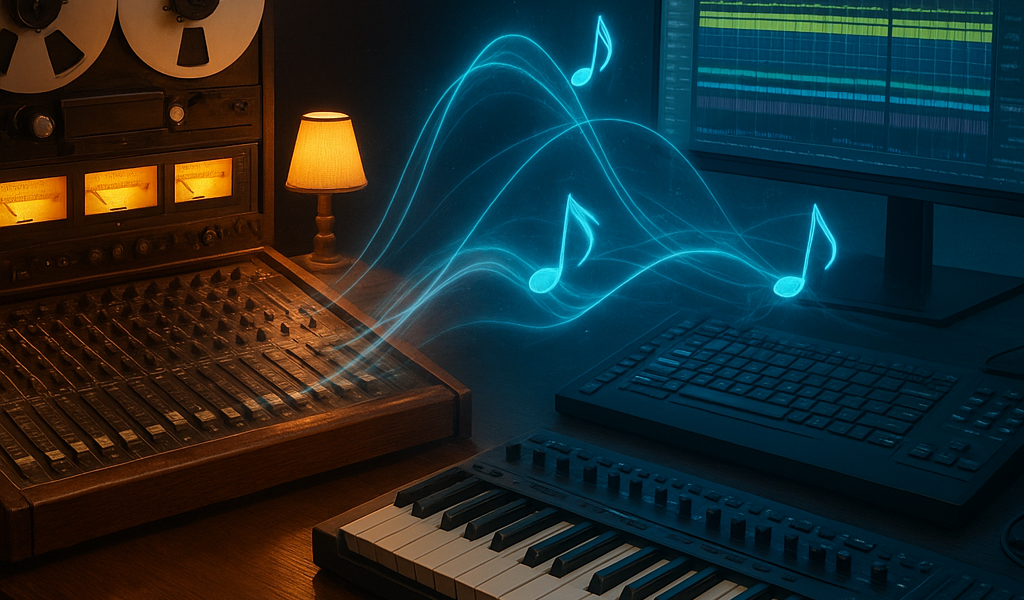
Music production has come a long way from the days of primitive recording horns and wax cylinders. What was once an art form constrained by the physical limitations of early technology has blossomed into one of the most technically sophisticated creative fields in existence. Today, a teenager with a laptop can produce tracks that rival the sonic quality of professional studio albums from just a few decades ago. That shift didn’t happen overnight — it’s the result of more than a century of relentless innovation, experimentation, and artistic courage.
Whether you’re a curious listener, an aspiring producer, or a seasoned audio engineer looking to revisit the roots of your craft, understanding how music production techniques have evolved over time adds a whole new layer of appreciation to the music you love. This article takes a deep dive into that journey — from the earliest acoustic recordings to the AI-assisted productions shaping the sound of tomorrow.
The Birth of Recorded Sound: Acoustic and Early Electric Eras
Before there was music production as we know it, there was simply performance. Music existed only in the moment it was played. That changed dramatically in 1877 when Thomas Edison invented the phonograph, a device capable of both recording and playing back sound. Shortly after, Emile Berliner developed the gramophone and introduced the flat disc record, which would become the dominant format for decades.
These early recordings were made using purely acoustic methods. Performers would cluster around a large horn connected to a diaphragm and stylus, which carved grooves directly into a rotating cylinder or disc. The process was unforgiving — no editing, no mixing, no second chances. If someone played a wrong note, the entire recording had to start over.
The introduction of electrical recording in the mid-1920s was a game-changer. Microphones replaced acoustic horns, and amplifiers allowed engineers to capture a much wider dynamic range. Suddenly, the nuances of a vocalist’s breath or the subtle decay of a piano note could be preserved with far greater clarity. This era also saw the rise of the first true “record producers,” individuals who began shaping the sound of recordings beyond just pressing a button.
The Magnetic Tape Revolution
Perhaps no single technology transformed music production more fundamentally than magnetic tape. Developed in Germany during the 1930s and brought to the United States after World War II, tape recording offered something that disc recording could not: the ability to edit. Engineers could physically cut tape with a razor blade and splice it back together, removing mistakes or rearranging sections of a performance.
Les Paul, the legendary guitarist and inventor, took this concept even further. In the late 1940s and early 1950s, he pioneered the technique of overdubbing — recording one track and then recording additional performances on top of it. This allowed a single musician to build up layers of sound, effectively becoming an entire band. His recordings with Mary Ford demonstrated this technique to a mass audience and planted the seed for modern multi-track recording.
The Studio as an Instrument: The 1960s and the Age of Experimentation
The 1960s were arguably the most creatively explosive decade in the history of music production. With the development of multi-track tape machines — first four-track, then eight-track, and eventually 16-track — producers and engineers gained unprecedented control over the recording process. The studio itself began to function less like a documentation tool and more like a creative instrument.
The Beatles and their producer George Martin were central to this transformation. Albums like Revolver (1966) and Sgt. Pepper’s Lonely Hearts Club Band (1967) showcased techniques that had never been heard before: reversed guitar tracks, tape loops, artificial double tracking (ADT), and the creative use of compression and equalization. These weren’t accidents — they were deliberate sonic choices made possible by pushing the technology of the time to its absolute limits.
Meanwhile, engineer and producer Joe Meek in the UK was experimenting with compression and reverb in ways that gave his productions a distinctly otherworldly quality. In the United States, Phil Spector developed the “Wall of Sound” — a dense, layered production technique that used large orchestras, multiple instruments playing the same parts, and heavy reverb to create a monumental sonic experience.
The Rise of Electronic Instruments
The 1960s also saw the emergence of electronic instruments that would permanently alter the palette of music production. The Moog synthesizer, developed by Robert Moog in 1964, allowed musicians to generate entirely new sounds using oscillators, filters, and envelopes. Albums like Wendy Carlos’s Switched-On Bach (1968) introduced synthesizers to mainstream audiences and proved that electronic music could be both technically impressive and emotionally resonant.
Drum machines began appearing in studios during the late 1960s and 1970s, initially as a novelty but increasingly as a practical tool. When Roland released the TR-808 in 1980, it gave producers a rhythmic foundation that would go on to define entire genres — from hip-hop to house to electro pop.
The Digital Revolution: From Analog Warmth to Digital Precision
The 1980s ushered in the digital age of music production, bringing with it both breathtaking new possibilities and fierce debates about the soul of recorded music. The introduction of the Compact Disc in 1982 marked a shift toward digital audio, while MIDI (Musical Instrument Digital Interface), standardized in 1983, allowed electronic instruments from different manufacturers to communicate with each other for the first time.
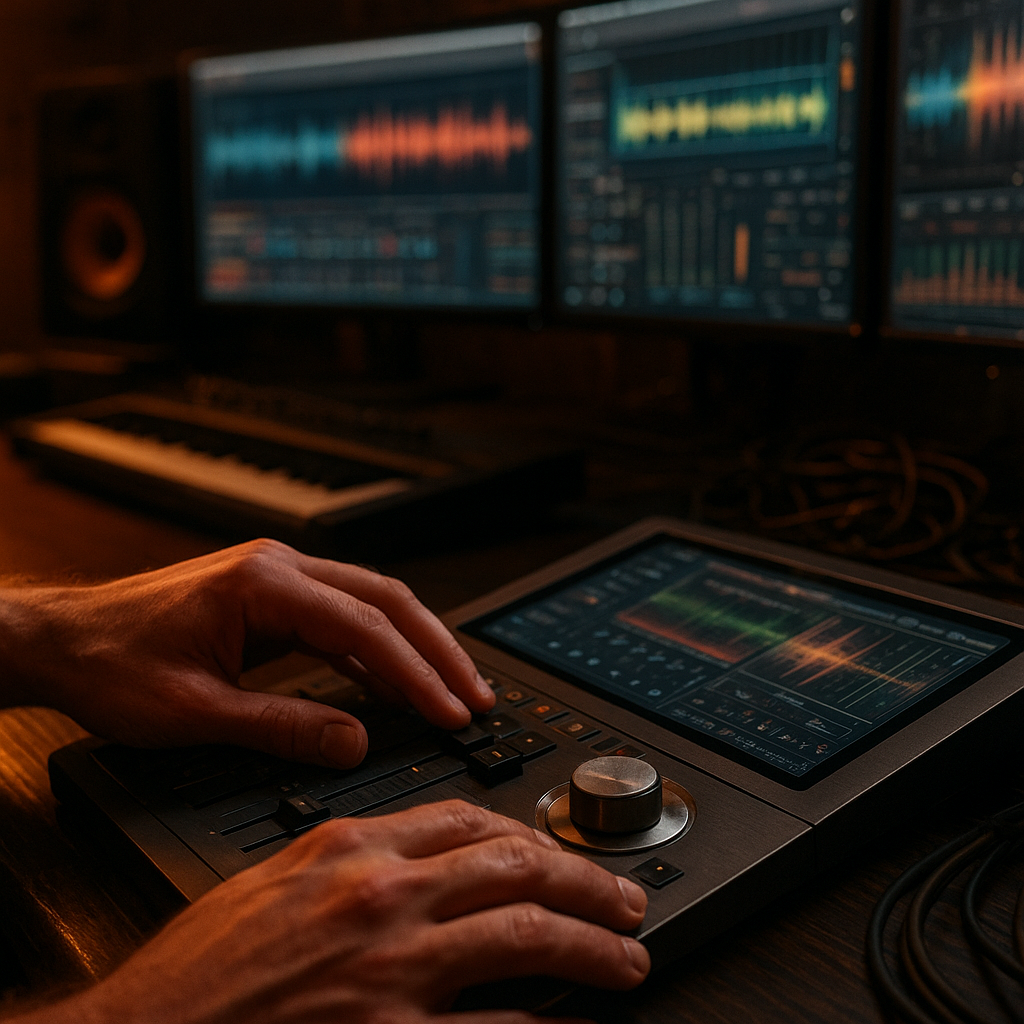
Digital Audio Workstations (DAWs) began emerging in the mid-1980s and fundamentally changed the workflow of music production. Instead of cutting tape with a razor blade, producers could now edit audio on a screen, moving and trimming recordings with a mouse. Early systems like the Fairlight CMI and the Synclavier were prohibitively expensive, but as personal computers became more powerful and affordable, software like Pro Tools, Logic, and Cubase brought professional-quality production capabilities to a much wider audience.
Sampling and the Birth of Hip-Hop Production
One of the most culturally significant developments in modern music production was the rise of sampling — the practice of taking a portion of an existing recording and incorporating it into a new piece of music. Hip-hop producers like DJ Premier, Pete Rock, and J Dilla elevated sampling to an art form, finding hidden beauty in old soul records, jazz albums, and obscure funk tracks.
The Akai MPC (MIDI Production Center), first introduced in 1988, became the defining instrument of this movement. Its combination of sampling capability, sequencing, and performance-friendly pad layout made it the go-to tool for beatmakers for decades. The creative conversation between original recordings and their sampled descendants has produced some of the most innovative music of the past 50 years.
The Home Studio Era: Democratization of Music Production
By the early 2000s, the barriers to entry in music production had dropped dramatically. A decent laptop, an audio interface, a pair of headphones, and a DAW license were all someone needed to start producing music at a genuinely competitive level. This democratization had profound consequences for the music industry as a whole.
Artists like Bon Iver, who recorded his debut album For Emma, Forever Ago in a remote Wisconsin cabin, and Billie Eilish, who made her breakthrough recording music in her brother’s bedroom, demonstrated that world-class music no longer required world-class budgets. According to a 2021 report by the music distribution platform DistroKid, the platform alone was distributing over 20,000 new songs to streaming services every single day — a volume that would have been unimaginable in the analog era.
Plugins, Virtual Instruments, and the Software Revolution
Software plugins have become the modern equivalent of outboard studio gear. VST (Virtual Studio Technology) plugins allow producers to use digital emulations of classic hardware compressors, equalizers, reverbs, and synthesizers at a fraction of the cost of the original equipment. Companies like Waves, iZotope, and Native Instruments have built entire ecosystems of professional-grade tools that run inside DAWs.
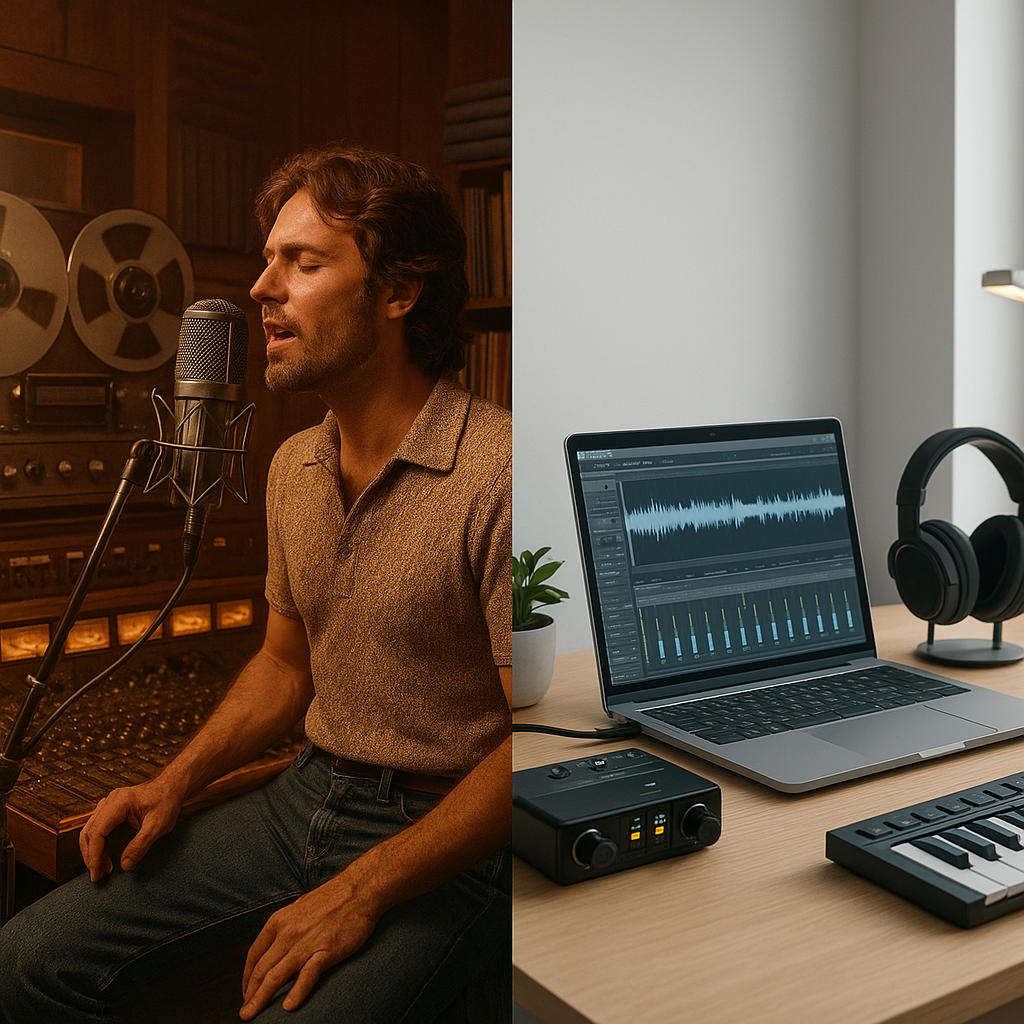
Virtual instruments — software synthesizers and sample libraries — have also reached extraordinary levels of realism. Orchestral libraries like Spitfire Audio’s BBCSO allow a composer working alone in a home studio to write and produce music that sounds genuinely like a live orchestra, opening up possibilities that were previously reserved for those with large budgets and connections.
Artificial Intelligence and the Future of Music Production
The most recent chapter in the evolution of music production is being written by artificial intelligence. AI-powered tools are beginning to assist — and in some cases entirely automate — aspects of the production process that once required years of trained expertise.
Tools like iZotope’s Ozone use machine learning to analyze audio and apply mastering settings automatically. Platforms like Suno and Udio can generate complete songs from text prompts. LANDR offers AI-powered mastering as a service. These developments raise important questions about creativity, authorship, and the role of human expression in music — questions the industry is still actively grappling with.
At the same time, many producers are using AI not as a replacement for human creativity but as a powerful new tool within it. Generating unique samples, automating repetitive tasks, and exploring sonic possibilities that would take hours to achieve manually are just a few of the ways forward-thinking producers are incorporating these technologies into their workflows.
Spatial Audio and Immersive Sound
Another significant frontier is spatial audio — production formats like Dolby Atmos that allow music to be mixed in three dimensions, surrounding the listener rather than simply coming from two speakers. Major streaming platforms including Apple Music and Amazon Music HD now support Atmos mixes, and many major releases are being produced with this format in mind. It represents a genuinely new listening experience and is beginning to influence how producers think about placement, movement, and depth in their mixes.
Conclusion
The evolution of music production techniques is ultimately a story about the ongoing dialogue between human creativity and technological possibility. From Edison’s phonograph to magnetic tape, from the Moog synthesizer to the DAW, from bedroom beatmakers to AI-generated compositions — each era has both expanded what’s possible and challenged producers to find new ways to express something genuinely human within it.
Understanding this history helps contextualize the music we hear today. The sonic choices made in a modern pop record or lo-fi hip-hop track carry echoes of decisions made by producers and engineers decades ago. The tools change, the genres shift, and the cultural contexts evolve — but the core pursuit remains the same: capturing something emotionally true and making it sound as powerful as possible.
As technology continues to advance at an accelerating pace, one thing seems clear: the art of music production will keep evolving, and the most innovative producers will always be those who understand where they’ve come from well enough to imagine where they might go next.